
Quick Answer
If you are researching BJJ for teenagers in Calgary, the short answer is yes — it is a good fit for most teens. Brazilian jiu-jitsu builds real fitness, confidence, and the ability to handle stress, without the social pressure that comes with team sports. Teens do not need prior experience to start, and at a well-run gym they will train alongside other beginners in a structured, coach-led environment. It is one of the few activities that challenges teenagers physically and mentally at the same time.
Most articles about martial arts for teens are written entirely for parents.
That makes sense. Parents are usually the ones doing the searching.
But teenagers have their own questions, and if those don’t get answered, the conversation at home tends to go one way: “I don’t want to do it.”
So this post is written for both of you.
If you’re a parent, you’ll find answers about safety, what to expect, and how to tell if your teen is a good fit for BJJ in Calgary.
If you are a teenager reading this — yes, this section is actually for you — you will find straight answers about what training is really like.
For Parents: What You Want to Know About BJJ for Teenagers in Calgary
Is jiu-jitsu safe for teenagers?
This is usually the first question.
Brazilian jiu-jitsu is considered one of the safer martial arts for teens because there are no punches or kicks in training. The sport focuses on grappling — getting a dominant position, taking someone to the ground, and applying controlled submissions like joint locks or chokes.
Teens learn to signal when they are uncomfortable through a tap, basically saying “stop,” and a good gym enforces that immediately and without question. Nobody pushes through pain to look tough.
That said, it is still a contact sport. Soreness, small bruises, and the occasional jammed finger come with the territory. Serious injuries are rare in a well-run program, but they are not impossible.
The biggest factor is the gym’s culture. A gym that pairs teens with appropriate training partners, coaches the room actively, and has zero tolerance for recklessness is a very different experience from one that throws beginners in the deep end. If you want a full breakdown of injury risks and what a safe program looks like, we wrote about that here: Will I Get Hurt Doing BJJ? Real Risks and How We Keep Beginners Safe.
Do teenagers train separately from adults?
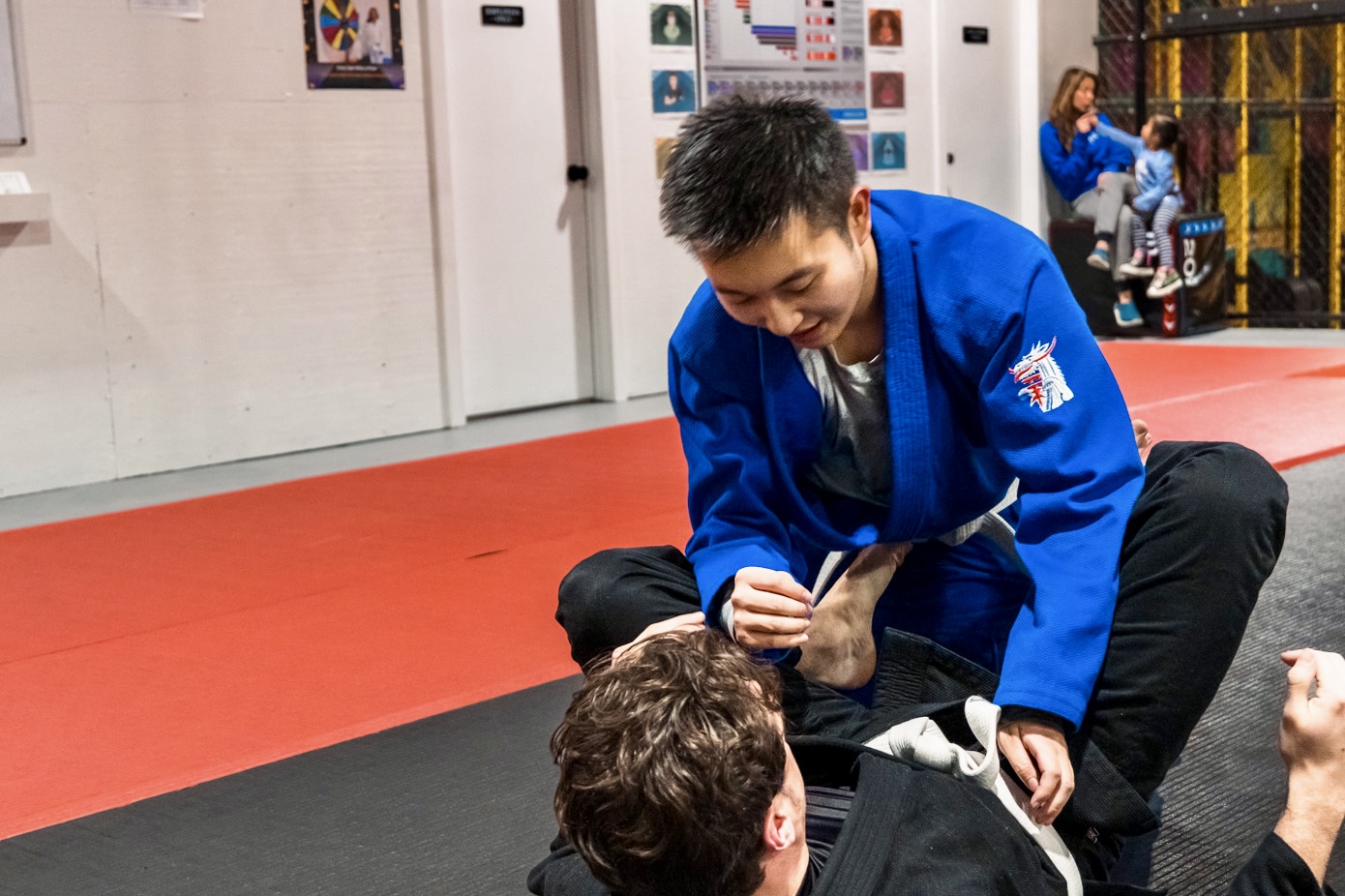
At SBG Calgary, teens and adults train in the same beginner program.
This surprises some parents, but it is actually one of the best parts of BJJ for teenagers in Calgary.
Teens do not get stuck in a kids class that feels too young for them, and they do not get thrown into advanced adult training they are not ready for. Our beginner program brings everyone in at the same starting point and progresses at a pace that makes sense for where you actually are.
In practice, a teenager will train alongside other teens, adult beginners, and more experienced students who know how to work carefully with newer people. Coaches match partners by size, experience, and temperament. A 14-year-old is not getting tossed around by a 35-year-old competitor.
Will BJJ help my teenager with focus and stress?
Many parents notice real changes in their teen after a few months of consistent training.
Some of what we see:
- Stress management. A one-hour class is a full mental and physical reset. After a hard round on the mat, whatever was stressing you out at school tends to feel smaller.
- Discipline and consistency. Progress in BJJ is slow and cumulative. Teens learn quickly that showing up matters more than being naturally talented.
- Confidence without ego. Getting tapped out a hundred times and coming back anyway teaches something you cannot get from a trophy. Teens figure out that hard things are survivable, and that carries over into other areas of life.
- Focus. Jiu-jitsu requires your full attention. You cannot zone out while someone is trying to submit you. That kind of engaged, problem-solving focus tends to develop over time.
None of this happens overnight. But it does happen with consistent training.
What if my teen has no athletic background?
Jiu-jitsu is unusually forgiving of athletic background, more so than most sports.
Strength helps a little. Speed helps a little. But technique, timing, and problem-solving matter far more at the beginner level. Teens who are not natural athletes often do very well in BJJ precisely because it rewards thinking and persistence over raw physical ability.
Teens who are new to exercise will get fit through training rather than needing to be fit before they start.
What does belt progression look like for teens?
Teens 16 and older progress through the same belt system as adults: white, blue, purple, brown, black. For those under 16, there is a ranking system specifically designed to break up progress into smaller, more achievable steps.
The realistic timeline for a blue belt is roughly 18 to 36 months of consistent training, meaning two to three classes per week. We wrote a detailed breakdown here: How Long Does It Take to Get a Blue Belt in BJJ in Calgary?
Belts are not the point for most teens — progress is. But the belt system gives them a clear way to track improvement, which tends to work well for teenagers who are used to grades and levels.
Is BJJ a good alternative to team sports for teenagers?
For some teens, yes — especially those who have had bad experiences with bench-warming, coach politics, or the social dynamics that come with team sports.
In jiu-jitsu, you are always training. There is no bench. Every class, every round, you are in it. Your progress belongs entirely to you. It does not depend on whether a coach plays you or whether your team has a good season.
There is still a strong social side. Teens build genuine friendships on the mat, partly because training together is an inherently bonding experience. It is hard to stay surface-level with someone after you have spent an hour trying to solve problems together.
For Teens: What You Actually Want to Know About BJJ in Calgary
If your parents are the ones who brought this up, that is understandable. Being told you should try something is rarely convincing on its own.
So here is the honest version.
What is it actually like?
A typical class runs about an hour.
You warm up, learn and drill techniques or positions with a partner, and then train those skills using progressive resistance so that you walk away with something tangible.
The learning curve is steep at first. You will not know what you are doing for a while. That is normal and expected, and nobody is judging you for it. Everyone in the beginner program started in the same place.
Is it embarrassing to be a beginner?
The short answer is no, and here is why.
In most sports, being bad is very visible. Everyone can see you miss the ball or fall behind on the court.
In BJJ, everyone is on the mat, everyone is learning, and making mistakes is the whole point of class. Getting tapped is not a big deal. It is just how you find out what to work on next.
After a few classes, most people stop thinking about it entirely. You are too focused on what you are trying to do to worry about how you look.
Do I have to be fit to start?
No. You will get fit by training.
The first couple of weeks might leave you winded. That goes away quickly. Most teens are in noticeably better shape after four to six weeks of training regularly.
What if I am not the fighting type?
Jiu-jitsu is not about being aggressive.
The people who do best in BJJ tend to be calm, patient, and good at solving problems — not the loudest or most intense people in the room. The whole art is built around using leverage and technique rather than relying on size or force.
If you are not someone who is naturally looking for a fight, you will probably fit in well.
What do I actually get out of it?
Honestly, that depends on what you put in.
If you show up once a week and go through the motions, you will have a casual hobby.
If you show up consistently and actually try, you will get fit, you will be able to handle yourself in a physical situation, you will have friends you trust, and you will find out pretty quickly that you are more capable than you thought.
That last part tends to carry over into everything else.
Gi or no-gi — which should I do?
At SBG Calgary, you will start in the gi, the traditional uniform. It slows things down and gives you more to work with, which makes technique easier to learn.
Once you have the basics, no-gi training (shorts and a t-shirt) is available too. We wrote a full breakdown here if you want the details: Gi vs No-Gi Jiu-Jitsu in Calgary: Best Choice for Beginners.
BJJ and Mental Health for Teenagers
This is worth saying directly.
Teenagers carry a lot right now. School pressure, social stress, phones that never stop, and a constant sense that everything is moving fast.
Training gives you an hour where none of that is happening. You have one job: figure out what your partner is trying to do and don’t let them. That is it.
A lot of teens describe training as the thing in their week that actually clears their head.
It’s not therapy, and it’s not a fix for serious mental health challenges. But as part of a healthy routine, consistent physical training that demands your full attention does something that most other activities do not. We have written more about this here: Can Jiu-Jitsu Help Mental Health?
What to Expect in a First Class at SBG Calgary
If you are curious but nervous about walking in, here is what actually happens.
You will come in, meet a coach, and get a quick rundown of how things work. You will follow along with the warm-up, watch and then try the technique being taught, and work through it with a partner. It is structured and coached. Rest assured, there is no full sparring in your first classes.
Nobody expects you to be good. They just expect you to pay attention and try.
For the full breakdown: What to Expect in Your First BJJ Class in Calgary.
Teen BJJ in Calgary at SBG
Straight Blast Gym Calgary teaches BJJ for teenagers in Calgary through a mixed-age beginner program where coaches actively run the room. We match training partners carefully, progress people at a real pace, and have zero tolerance for the kind of culture that makes some gyms uncomfortable for new people.
We are located at 401 33 St NE Unit 8, Calgary — near Marlborough Mall.
If you want to see it before committing to anything, the best move is to book a free introductory class. You and your teen can meet the coaches, see the space, and do a first class with no pressure and no obligation.
FAQ
Yes. Brazilian jiu-jitsu works well for most teens because it challenges them physically and mentally, builds real confidence, and doesn’t require any prior athletic experience. Teens progress at their own pace rather than depending on a team or a coach’s lineup decisions.
At SBG Calgary, teens can join the adult beginner program. We also offer kids’ classes for younger children. Most teens from 13 and up fit well into the adult beginner program, and we’ll help you figure out the right fit when you come in.
Yes, when taught at a properly run school. BJJ has no punching or kicking in training, and students learn to tap (signal “stop”) early. A good gym pairs teens with appropriate partners and coaches the room actively. Minor soreness and bruising are common; serious injuries are rare in a well-run program.
At SBG Calgary, teens train in the same beginner program as adult beginners. Coaches match partners by size, experience, and attitude. Teenagers aren’t paired with advanced adults in sparring — they train with other beginners at a pace that makes sense for where they are.
Most teens notice a genuine shift in confidence after a few months of consistent training. It doesn’t come from being told they’re great — it comes from doing something hard repeatedly and getting better at it. That kind of earned confidence tends to show up in other parts of life too.
Comfortable athletic clothes are fine for a first class — shorts and a t-shirt, or athletic pants. You don’t need a gi (the traditional uniform) right away. Coaches will let you know what to get once you decide to join.
No. Jiu-jitsu rewards patience, problem-solving, and technique more than raw athletic ability, especially at the beginner level. Teens with no sports background do well. Fitness will improve through training itself.