
Quick answer
In most cases, kids do not quit martial arts. Parents do. Not because they are bad parents, but because martial arts often gets treated as optional. When training becomes hard, many families open the exit door too early. If your child is in the first six months of jiu-jitsu or martial arts, a motivation dip is normal. The better response is usually to stay consistent, talk to the coach, and avoid making quitting decisions on a hard day.
The question I get asked more than almost any other
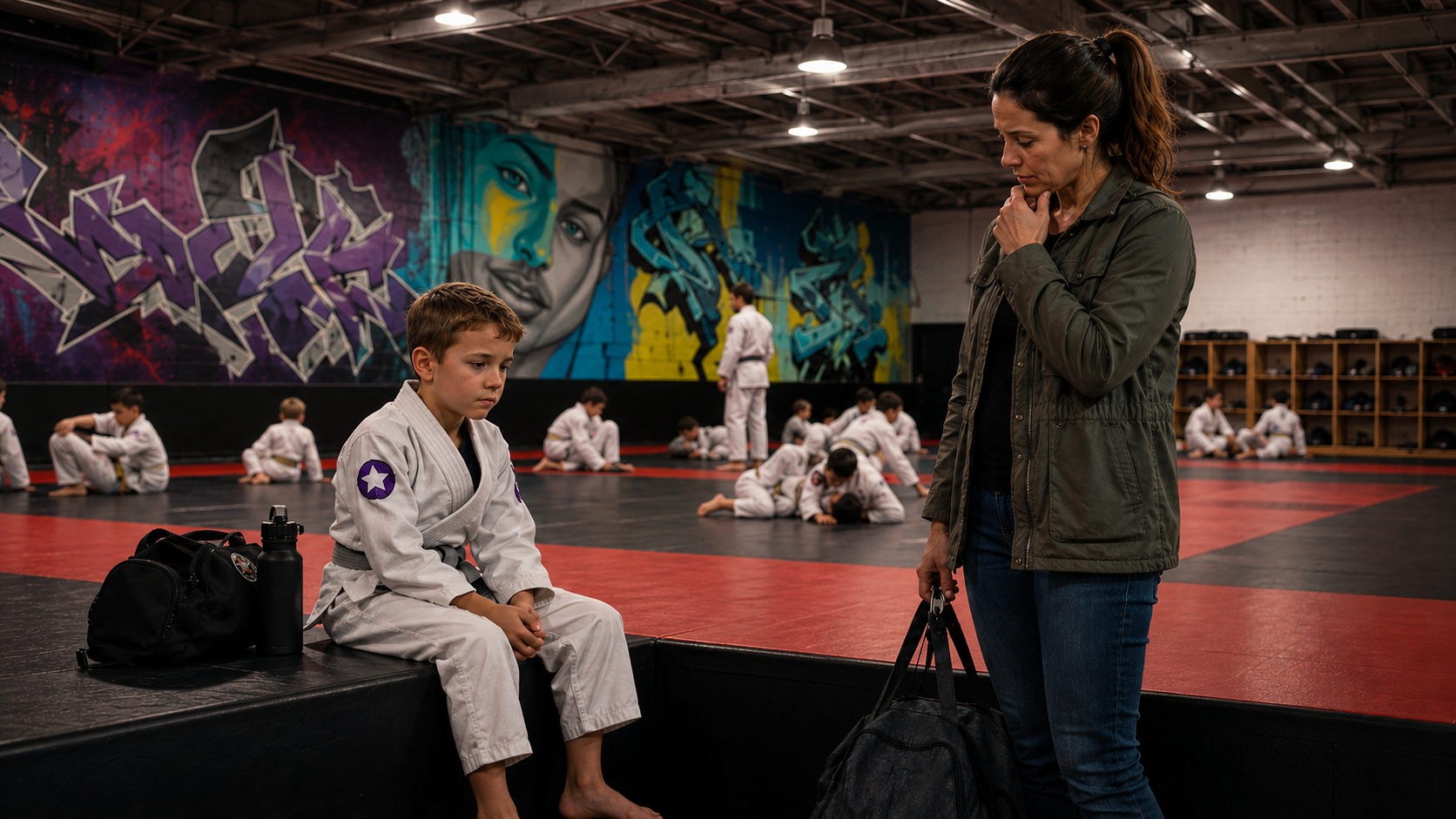
A parent pulls me aside after class. Their child is somewhere between two and twelve months in. Things started well, but lately the drive to the gym has turned into a negotiation. Their kid is dragging their feet. Some nights there are tears.
The parent says something like: “I think he’s just not into it anymore. Maybe it’s not for him.”
Every time I hear this, I ask one question back:
“Does he still brush his teeth?”
They always laugh. Then they get it.
Most kids settle in just fine
Before anything else, it is worth saying this clearly: most kids who start martial arts at Straight Blast Gym Calgary take to it well. They make friends, they progress, they surprise themselves. The majority of families never have a serious quitting conversation at all.
But after more than 40 years of coaching, I’ve noticed that most kids hit one predictable moment of resistance somewhere along the way. It may happen at the two-week mark, the two-month mark, or maybe not until a couple of years have gone by. It rarely lasts long. And parents who know it is coming handle it completely differently than parents who don’t.
That is what this post is about. Not a constant battle, but one moment you may face, and exactly what to do when you do.
Why teeth brushing is the whole point
Think about all of the things your child does every single day that they don’t particularly enjoy:
- Brushing their teeth
- Going to school
- Going to bed on time
- Eating their vegetables (or at least being made to try)
None of those things have ever been described by a child as fun. Kids resist all of them at some point. But no parent in Calgary, or anywhere else, holds a family meeting to ask whether teeth brushing “is really their thing.”
We hold the line because we understand that certain actions build something important, and short-term discomfort is part of the process.
Martial arts is one of those things. But because it lives in the “optional activity” column alongside skating lessons and soccer registration, it gets treated differently. Kids are given a vote they’re not developmentally ready to cast wisely.
What’s actually happening when a child says “I don’t want to go”
When the resistance comes, it almost never means “this is genuinely wrong for me.” In most cases it means one of the following:
They had a hard class. They got stuck. They felt clumsy. Another kid was better than them. This is not a sign that martial arts isn’t for them. This is martial arts working exactly as intended.
They’re in a natural dip. The first few months are exciting. Then the novelty wears off and the real learning starts. This dip happens in every skill: music, swimming, languages, sport. It is not a sign to quit. It’s a sign you’re about to make real progress.
Something else sounds more fun right now. Kids are built this way. A new video game came out. A friend stopped coming to class. Screen time is calling. This is completely normal. It’s also why parents, not children, need to make the call on continuity.
They feel behind. If they’ve missed a few classes, they sometimes feel embarrassed to come back. The gap feels bigger than it is. Left unaddressed, this becomes an excuse to stay home permanently.
None of these are good reasons to quit. And in almost every case, one consistent response from a calm parent is all it takes to move through it.
The real decision-maker in the room
Here’s the uncomfortable truth: when a child under twelve “quits” martial arts, what’s really happening is a parent agreed to let them.
That is not a criticism. It is an observation. Parents are kind. Parents hate seeing their kids uncomfortable. And when the request to quit comes at the end of a long week, after a tough commute across Calgary to make the 5:05 class, it can feel easier to just say yes.
But “easier right now” and “better for them” are often different things.
One of the parents at SBG Calgary, Jacqueline Flores, described enrolling her daughter as their best decision ever, one that changed their life for the better. She didn’t say that after the first class. She said it after watching what happened when they kept showing up through the hard moments.
We see it constantly: kids who arrive in a rough mood and leave happy. That pattern, hard to get there but great once you’re in it, is one of the most reliable signs that a child is exactly where they should be. It’s exactly the pattern that gets lost when a parent lets one bad arrival become a permanent exit.
What to do when the moment arrives
The parents whose kids build real confidence and stick with martial arts long-term tend to handle that one moment the same way.
They don’t make the decision on a hard day. They have a rule: no quitting discussions on the drive home after a tough class. They sleep on it. Usually by morning it’s not an issue.
They keep the focus small and forward. The next stripe. The next technique. The next class. Big commitments feel heavy when motivation dips. The next small win never does.
They talk about effort, not outcomes. They ask “what did you learn?” instead of “did you win?” That one shift changes how a child experiences the tough nights.
They treat attendance like a non-negotiable. Same as school, same as the dentist, same as hockey practice during a Calgary winter when nobody wants to leave the house. Martial arts is on the calendar and we go. Kids actually feel safer when the routine is steady. The negotiation itself creates more anxiety than the class.
They tell the coach what’s going on. This is underused. A quick text message to us before class, something like “he’s been reluctant lately,” lets us make small adjustments without making the child feel singled out. A good coach can turn a hesitant kid around fast when they know what’s underneath it.
For a deeper look at what the best martial arts parents do differently, read How to Be a 5-Star Jiu-Jitsu Parent.
Why Brazilian jiu-jitsu specifically handles this better than most martial arts
Not all martial arts are built equally when it comes to keeping kids engaged through the hard patches.
A lot of striking-based arts like karate and taekwondo rely heavily on forms and repetition that can feel abstract to young kids. They learn moves without immediately understanding why, which makes the dip feel worse and the progress feel invisible.
Brazilian jiu-jitsu is different because the feedback is immediate and honest. When something works on the mat, the child feels it. When something doesn’t, they feel that too. There’s no pretending. That direct feedback loop keeps kids more connected to their progress, even when progress feels slow.
That process is also exactly how jiu-jitsu builds the kind of confidence that transfers outside the gym, which we break down in How Jiu-Jitsu Helps Kids Build Confidence.
It’s also a problem-solving art. Every round is a puzzle. That keeps curious, active kids mentally engaged in a way that pure drilling often doesn’t.
At Straight Blast Gym Calgary, we teach BJJ specifically because after nearly four decades of coaching across multiple disciplines, it consistently produces the most durable confidence we’ve seen in kids who stick with it, provided their parents stay the course.
When it actually is okay to take a break or stop
This isn’t about never quitting anything. The goal isn’t to raise kids who grind through misery. It’s to help them learn the difference between “this is hard” and “this is wrong for me.”
There are real reasons to stop or pause:
- The environment feels genuinely unsafe or unkind (this should never describe SBG, but it’s worth saying)
- A significant injury that needs proper rest
- A major life change such as a move to a new city, a family crisis, or a health issue that makes training genuinely unsustainable for a stretch
What’s not on that list: one bad class, three weeks of resistance, a friend quitting, or “they seem bored right now.” Those are hard moments. Hard moments are where growth lives.
If you want to know what kids who did quit usually say years later, The Crystal Ball Talk is worth a read.
A word specifically for the first six months
If you’re reading this and you’re in months one through six with your child, you are in the most important window of their martial arts journey.
This is the period where habits get set. Where they learn whether training is a real commitment or something that dissolves when it gets difficult. Where the foundational movements start to click, but only if they stay long enough for repetition to do its job.
Most kids in this window hit that one moment of resistance we talked about earlier. When it comes, you will be ready for it. You will know it is temporary. You will keep the routine.
If you want the full picture of what that support looks like in practice, How Parents Help Their Child Succeed in Jiu-Jitsu covers it in detail.
Those are the kids we watch flourish over the following year. And those are the parents who eventually say some version of what Jacqueline said: that this was one of the best decisions they ever made.
Frequently Asked Questions
Give it more time before deciding. Most kids hit a natural motivation dip and come out the other side stronger for it. Talk to the coach, keep showing up, and watch what happens over the next month. The kids who push through this moment are almost always the ones parents later describe as transformed.
Ask yourself: do they enjoy themselves once they’re on the mats, even if they resisted going? If yes, that’s a hard patch, not a bad fit. A bad fit usually looks like persistent distress during class, not just resistance beforehand.
Stay calm and don’t negotiate in the parking lot. A simple line that works well: “I hear you. We’re going anyway. You’ll feel better after.” Then follow through. One calm, firm response is far more effective than a long discussion.
Usually it means they don’t feel progress yet. Ask the coach to give your child a small, specific thing to focus on in the next class. A mini-mission they can collect a win from. Progress is the cure for boredom.
Yes, completely. Most kids resist at some point in the first year. Some resist regularly and then enjoy themselves the moment class starts. That pattern of reluctance before class and happiness after is one of the most common things coaches see. Keep the routine steady.
Remind your child they’re training for themselves, not for their friend. A quick word to the coach lets them pair your child with another consistent training partner, which usually resolves it within a class or two.
At minimum, get through the first six months with consistent attendance before making any decision. Ideally a full year. The changes in confidence, composure, and physical capability that parents describe in reviews almost always happen between months three and twelve, and only for kids who stayed.
It’s real, and the mechanism is specific. Jiu-jitsu puts children in controlled, uncomfortable situations and teaches them to stay calm, problem-solve, and keep going. That’s not something you can get from a classroom. The confidence parents notice isn’t performance confidence — it’s earned confidence. It comes from doing something hard repeatedly.
Ready to see what sticking with it looks like?
At Straight Blast Gym Calgary, we work with kids from across the city — NE, NW, SE, SW — in a structured, beginner-friendly program taught by a husband-and-wife black belt team with nearly four decades of coaching experience between them.
If your child is in their first year and you’re not sure what to do next, come talk to us. We can help you figure out the right path.
Book a free trial class and we’ll show both you and your child what staying looks like.
Straight Blast Gym Calgary is located at 401 33 St NE Unit 8, Calgary, AB — near Marlborough Mall, easily accessible from all quadrants of the city.
