
If you’re a parent in Calgary wondering whether jiu-jitsu can help a child with ADHD, the answer is that it often can. Brazilian Jiu-Jitsu provides a structured environment where kids practise focus, self-control, and problem solving during every class. Some research suggests BJJ and other martial arts can improve areas like hyperactivity/inattention and aspects of executive function, though results vary by child and program quality. After decades of coaching, we’ve worked with many kids who struggle with focus and impulsivity, and while every child is different, the right training environment can make a noticeable difference over time.
This article is for education only and isn’t medical advice. If you have concerns about ADHD, talk to your child’s healthcare provider.
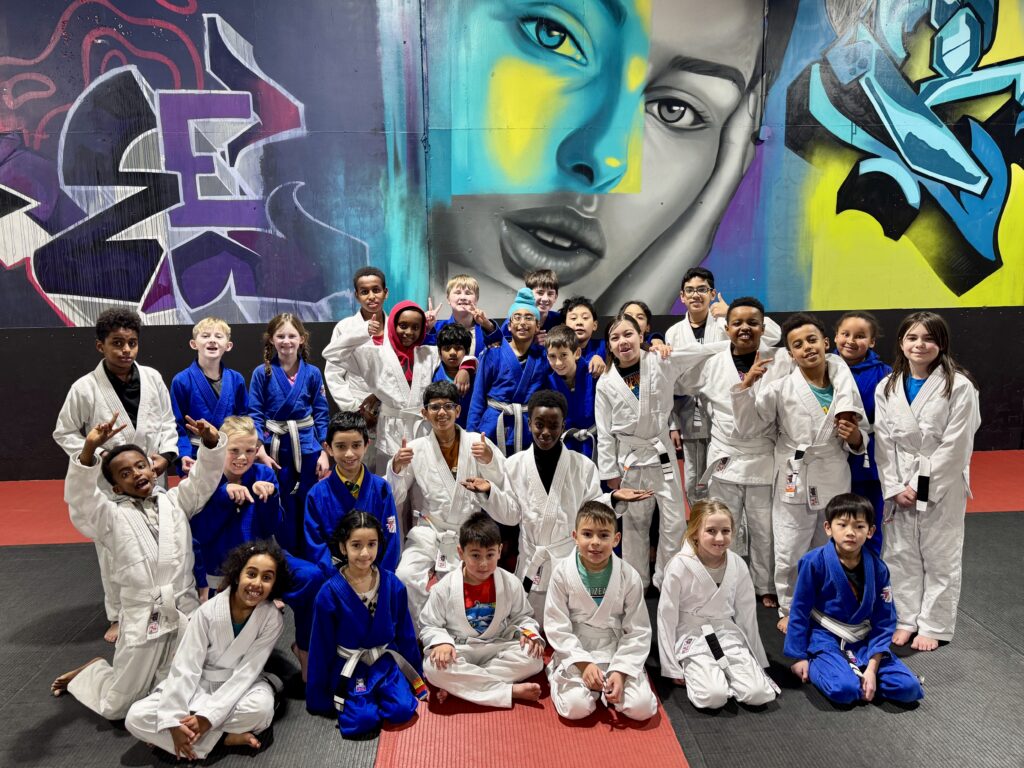
If you’re parenting a child with ADHD, you already know the pattern.
They’re bright, creative, and full of life, but day-to-day stuff can feel harder than it should. Sitting still. Waiting their turn. Handling frustration. Staying focused long enough to finish what they started.
So when you hear “Jiu-Jitsu helps kids with ADHD,” the real question is simple:
Is that actually true, or is it just a nice story?
Let’s look at what the research actually suggests, then I’ll give you a practical checklist for figuring out if Brazilian Jiu-Jitsu is a good fit for your child.
Quick answer: Can Jiu-Jitsu help kids with ADHD?
It can help some kids. The best research we have suggests that structured martial arts and physical activity programs can improve things like hyperactivity/inattention and parts of executive function (skills like self-control, working memory, and attention).
But it’s not a “treatment” by itself, and outcomes vary by child, program quality, and consistency.
Key Takeaways:
- Some studies suggest martial arts training may improve hyperactivity/inattention and parts of executive function.
- Results vary, and program quality and consistency matter a lot.
- Jiu-Jitsu can be a helpful complement, but it’s not a replacement for professional ADHD care.
What the research says about Brazilian Jiu-Jitsu and attention
1) A school-based BJJ trial found reduced hyperactivity/inattention
One of the most relevant studies looked at a 12-week school-based Brazilian Jiu-Jitsu program compared to standard physical education. Teachers completed a behavioural questionnaire before and after.
Result: BJJ participation was linked with a significantly larger decrease in hyperactivity/inattention (plus other behaviour and mental health measures) compared to regular PE.
That doesn’t mean “BJJ treats ADHD,” because the study wasn’t limited to diagnosed ADHD kids, but it does target the same behaviour bucket many parents care about.
2) BJJ practice has been linked with improved inhibitory control
Another school study (quasi-experimental) looked at inhibitory control, basically the ability to pause, filter impulses, and make a better choice.
They found measurable improvements, and kids who attended more classes tended to show stronger effects.
Again, not an ADHD-only study, but inhibitory control is one of the exact areas many ADHD kids struggle with.
What we can borrow from other martial arts ADHD studies
Even when research isn’t BJJ specifically, it helps answer the bigger question: Can structured martial arts improve attention and self-regulation in ADHD?
- A randomised trial in adolescents with ADHD found Taekwondo improved selective attention on standard cognitive tests after training.
- A judo RCT in children with ADHD found improvement in visuospatial working memory, and described judo as potentially helpful as a complement alongside usual care.
But it’s not all one-way:
- A separate analysis of two judo RCTs found judo may be ineffective for response inhibition in children with ADHD in that program and time window.
So the honest takeaway is:
Martial arts can help, but the “how” matters. Coaching style, class structure, and matching the program to the child matters a lot.
Why Jiu-Jitsu can be a great fit for ADHD brains (in plain English)
This part is not a medical claim. It’s the practical “why it often works” explanation many parents recognize immediately.
Brazilian Jiu-Jitsu tends to work well for some kids with ADHD because it’s:
- Engaging by default: You can’t drift off when there’s a partner in front of you.
- Short feedback loops: Try a movement, get instant feedback, adjust, repeat.
- Structured, but not boring: Clear rules and routines, with a new problem to solve every round.
- Physical outlet with boundaries: Kids get to move hard, but inside a controlled system.
- Progress-based: The child can feel improvement, which builds motivation.
If your child struggles in “stand in a line and wait” activities, Jiu-Jitsu is often a better match than sports with long pauses and lots of watching.
If confidence is one of your main goals, here’s a deeper breakdown of how training builds it over time.
What this does NOT mean
This part matters.
- Jiu-Jitsu is not a replacement for ADHD assessment, behaviour supports, or medication when that’s needed.
- “More activity” doesn’t automatically mean “better symptoms.” The program has to be taught well and be the right fit.
- If a gym runs chaotic classes, puts kids into intense sparring too soon, or uses shame-based coaching, you can get the opposite of what you want.
Physical activity is widely recommended as part of a healthy lifestyle for kids with ADHD, but it’s still one piece of the puzzle.
A parent’s checklist: How to choose a martial arts program for a child with ADHD
If you’re considering Jiu-Jitsu, look for these:
Green flags
- Classes follow a predictable structure (welcome, warm-up, skill, game, wrap-up)
- Coaches give clear, short instructions
- There’s positive reinforcement, not yelling
- Kids get chances to succeed early (simple wins)
- Safety rules are taken seriously
- The gym encourages parents to share helpful context about the child
Red flags
- No real class plan, it’s “whatever happens”
- Coaches publicly shame kids
- Kids are thrown into hard sparring right away
- Behaviour is managed with punishment instead of structure
How often should a child train?
Most families see the best results with 2 classes per week for consistency. That lines up with how many martial arts programs are built, and it’s realistic for families to maintain long-term.
If you do 2 classes a week for 3 months, you’ll usually know whether it’s helping. If you’re wondering what consistency looks like over the long haul, here’s why Jiu-Jitsu isn’t seasonal and why that matters for kids.
How we approach this at SBG Calgary
At Straight Blast Gym Calgary, we don’t pretend Jiu-Jitsu “cures” anything.
What we do focus on is building the skills parents want their kids to have:
- listening under pressure
- taking turns
- handling frustration
- trying again after failure
- staying calm in uncomfortable moments
If you want to see how our kids programs are structured by age, you can view our full class schedule here.
Want to see if this would help your child?
If your child has ADHD (or simply struggles with focus, impulse control, or confidence), the best next step is a simple conversation. We’ll talk about what’s going on, recommend the right age group (3–4, 5–7, or 8–12), and if it looks like a fit, we’ll book a 1-on-1 introductory lesson so your child feels supported from day one. No pressure — we’ll tell you honestly if we think it’s a good fit.
Sources and further reading
Below are a few of the studies and high-level references this post is based on.
Brazilian Jiu-Jitsu (school studies)

Bueno JCB et al. “Effects of a school-based Brazilian jiu-jitsu programme on mental health and classroom behaviour…” (randomised trial)

Bueno JCB & Saavedra L. (2016). “Brazilian Jiu-Jitsu and inhibitory control: effects of practice…”

Martial arts and ADHD (full-text research)

Kadri A. et al. “Effect of Taekwondo Practice on Cognitive Function in Adolescents with ADHD.” (PubMed Central full text)

Ludyga S. et al. (2022). “Judo training and working memory capacity in children with ADHD: a randomised controlled trial.” (PubMed Central full text)

Ludyga S. et al. (2023). “Martial arts and cognitive control in children with ADHD: combined analysis of two RCTs.” (PubMed Central full text)

Physical activity and ADHD (broader evidence + guidelines)

Frontiers in Neuroscience (2023). “Network meta-analysis of physical activity interventions for children with ADHD.”

Pediatrics (AAP) (2022). “Chronic Exercise for Core Symptoms and Executive Function in ADHD.” (abstract page)

CDC. “ADHD Treatment” (includes physical activity as part of a healthy lifestyle).
Frequently Asked Questions About Jiu-Jitsu for Kids with ADHD
It can be. Some studies on BJJ and other martial arts show improvements in areas like hyperactivity/inattention and parts of executive function. Results vary by child and by program quality, so the best approach is to try a well-structured class for a few months and watch what changes.
No. Jiu-Jitsu can be a helpful complement, but it is not a replacement for assessment or evidence-based treatment. If your child is under medical care, keep that in place and view martial arts as one supportive piece of a bigger plan.
Two classes per week is a strong baseline for most families. It’s frequent enough to build momentum and routine, but not so much that the child burns out.
That’s common at the start. A good kids program uses short instruction, frequent movement, and clear routines. Most kids improve as they learn what’s expected and start experiencing small wins.
It can be very safe when taught properly. Look for a school that prioritizes control, structure, and age-appropriate training, and doesn’t rush kids into intense sparring.
We run age-based kids programs for 3 to 4, 5 to 7, and 8 to 12, plus teens and adults, so kids can train with peers and get coaching that matches their stage of development.
Pingback: duspatal