
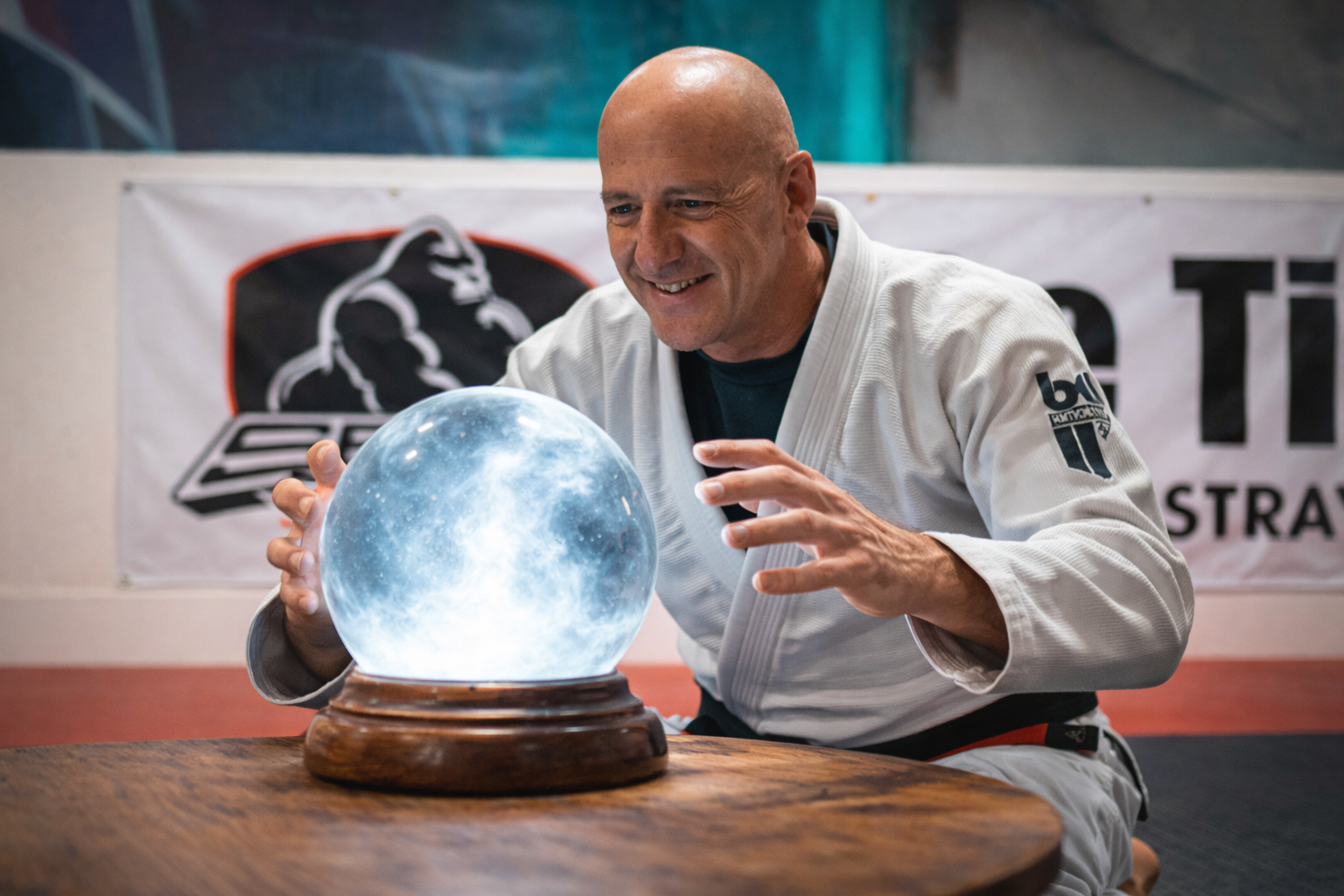
Every coach has a moment they see over and over.
A kid has a tough class. They feel frustrated. They feel tired. Maybe they got stuck. Maybe they were embarrassed. Maybe their friend quit. Maybe something else sounds more fun.
And then they say the sentence:
“I think I want to quit.”
I’ve had this conversation with kids and parents here in Calgary since we first opened our school, and the pattern is always the same.
When that happens, I usually tell them a story.
Not a lecture. Not a guilt trip. A story.
I call it the crystal ball talk.
I’ve been teaching martial arts for almost 40 years, and I’ve seen what happens when kids quit too early.
Quick answer
Most kids who quit jiu-jitsu do not quit because it is “not for them.” They quit because they hit a normal hard moment, and they do not yet have the skill of pushing through it. If a child quits every time something feels uncomfortable, they learn a dangerous lesson: “I stop when it gets hard.” If they stay, they learn the opposite: “I can do hard things.”
That lesson matters a lot more than any technique they learn this week.
My crystal ball (and what it predicts)
I tell kids I have a crystal ball.
I tell them I can see into the future.
Then I explain why I say that.
Because I have been coaching for a long time, and I have had the same conversation with adults more times than I can count.
A grown adult will come into the gym, look around, and say something like:
“I used to do martial arts when I was a kid.”
And then their voice changes.
You can hear it. There is a little pain in it.
“I wish I never quit.”
They do not say that because they miss a belt colour.
They say it because they know what they gave up.
They gave up confidence that comes from experience. They gave up capability. They gave up the kind of calm you only get when you have done hard things repeatedly and survived them.
That is why I say it feels like a crystal ball.
Because when a kid wants to quit, I can predict what a lot of them will say years later.
Kids do not see the real prize
Kids think the prize is a stripe. Or a belt. Or winning a round. Or being “good.”
That is not the real prize.
The real prize is what jiu-jitsu builds inside them over time:
- confidence
- composure
- grit
- resilience
- self-control
- the ability to keep going when things feel hard
And those are life skills. Not just gym skills.
The resume moment
This is another part of the crystal ball story.
I tell kids to imagine they are older and applying for jobs one day.
They will list school, work experience, and accomplishments.
Now imagine you get to write this on your list:
Brazilian Jiu-Jitsu Black Belt
That is not a normal accomplishment.
That tells the world something important about you:
- you can commit to something for the long term
- you can learn hard skills
- you can deal with pressure
- you can keep showing up
- you can get through setbacks
- you can finish what you start
That is rare.
And it matters.
Even if your child never becomes a black belt, the path toward it shapes who they become.
The million-dollar question
Then I tell them one more thing.
I have met a lot of black belts in Brazilian Jiu-Jitsu. I have trained with them, coached alongside them, and watched what jiu-jitsu has done for their lives.
And I do not know a single one who would trade their skill for a million dollars.
Not one.
Because the skill is not just “moves.”
It is confidence you carry everywhere. It is the ability to protect yourself. It is the calm that comes from knowing you can handle yourself in uncomfortable situations. It is humility and capability at the same time.
Once you have that, you do not want to give it back.
That is why I tell kids it is like I can predict the future.
Because I know what is waiting on the other side of consistency.
Why kids really quit
In my experience, most kids quit for reasons that have nothing to do with jiu-jitsu itself.
Here are the most common ones:
1) They hit their first hard season
They stop winning. They get stuck. They feel uncomfortable. They feel like they are “not good.”
That is normal.
2) They compare themselves to someone else
Maybe another kid is more athletic. Or more experienced. Or more confident.
Comparison kills motivation fast.
3) They miss a few weeks and feel behind
Then they feel embarrassed to come back, so they stay away longer.
4) They want the reward without the process
That is not a kid problem. That is a human problem.
5) Something else looks more fun this month
Kids are kids. Their interests change fast.
That is why parents matter in the decision.
What I tell parents (because this is the key)
If your child wants to quit, do not panic.
Do not shame them. Do not force them. But also do not treat quitting like it is always the right answer.
Here are a few questions that help:
“Is this a hard moment, or is it truly a bad fit?”
A hard moment is usually a growth moment.
“Are we quitting because it is inconvenient, or because it is harmful?”
Those are very different things.
“What lesson are we teaching if we quit right now?”
Kids learn patterns. If the pattern becomes “I quit when I feel uncomfortable,” that shows up later in school, friendships, and work.
“What would ‘staying’ look like?”
Sometimes staying means reducing the schedule, not quitting completely.
A better goal than “never quit”
I am not trying to raise kids who never quit anything.
I am trying to help raise kids who learn to tell the difference between:
- quitting because something is hard, and
- quitting because something truly is not right for them
That is a grown-up skill.
And jiu-jitsu is one of the best places to practice it.
For Calgary parents: what to do if your child wants to quit
If you are in Calgary and your child is training, here is a simple plan that works.
Step 1: Do not decide on a hard day
Make a rule: no quitting decisions made on the drive home after a tough class.
Step 2: Commit to a short “finish strong” block
Agree to a time frame, like:
- “Let’s do 4 more classes.”
- “Let’s finish this month.”
- “Let’s train until the next stripe assessment.”
Short blocks feel manageable.
Step 3: Focus on attendance, not outcomes
The goal is not to “win.”
The goal is to show up.
Step 4: Tell the coach what is happening
A good coach can adjust how they support your child without making them feel singled out.
The truth
Most kids who stay in jiu-jitsu long enough eventually have a moment where they realize:
“I’m glad I didn’t quit.”
That moment is worth protecting.
And that is why I keep my crystal ball handy.
FAQs
Yes. Most kids have phases where they feel frustrated, tired, or discouraged. That is often a sign they are learning something real.
It depends. If the environment is unsafe or unhealthy, leaving makes sense. But if it is simply a hard season, it is often better to set a short goal and help them finish strong.
Reduce pressure, praise effort, keep attendance consistent, and avoid making quitting the “easy out” after a tough class. Many shy kids become confident over time when they feel safe and supported.
Usually months, not days. Confidence grows through repetition and small wins. The change is often gradual, then suddenly obvious. Check out our post How Jiu-Jitsu Helps Kids Build Confidence.
Stay calm and keep the routine. Most kids settle once class starts. If it keeps happening, tell the coach so we can adjust pairings and expectations.
Usually it means they don’t feel progress yet. Give them one small mission for the next class so they can collect a win.
That’s common. Remind them they’re doing this for themselves, not their friend. Ask the coach to help them connect with another training partner.
Tell the coach. We can control pairings and fix it fast. Kids should feel challenged, not unsafe.
Quick and private. Tell us what your child said and what you think is behind it. We can’t help with what we don’t know. If it helps, we can set aside a few minutes to talk privately and sort out a plan.
Want help figuring out the best next step?
If you are in Calgary and you are not sure whether your child should continue, come talk to us.
At Straight Blast Gym Calgary, we work with kids at different ages and personalities, and we can help you decide what is best for your child.
If you are new and looking for a beginner-friendly kids program in NE Calgary near Marlborough Mall, you can book a free intro and see how we coach.
Book a free intro lesson and we will help you find the right path forward.
Pingback: dapoxetine hydrochloride
Pingback: zyloprim 300 generico