
Quick answer
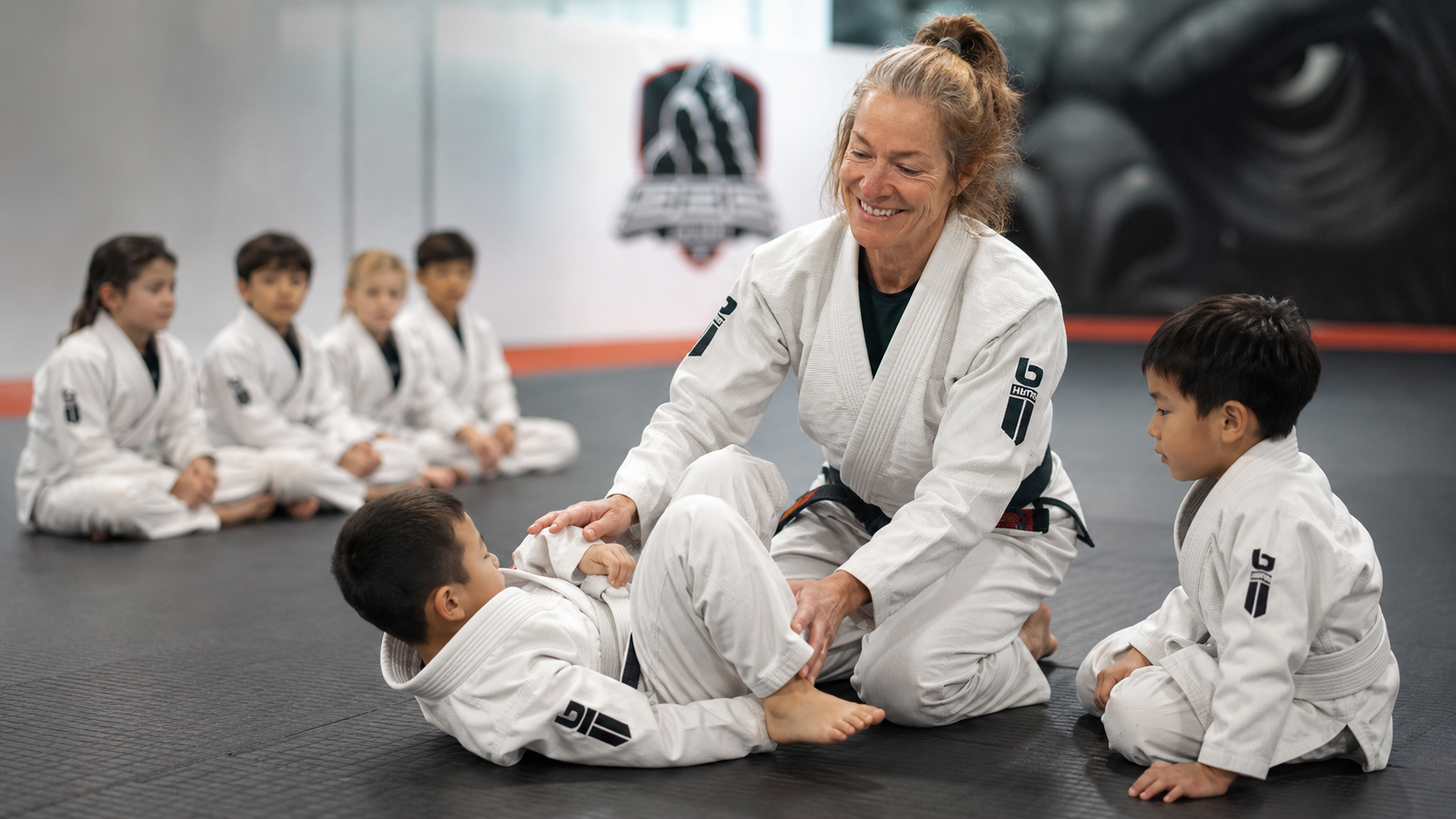
Jiu-jitsu helps kids become calmer because it teaches them how to handle pressure in a safe, structured environment. Instead of panicking, quitting, or reacting emotionally when something feels difficult, children learn to breathe, think, and keep going. If your child in Calgary struggles with big emotions, frustration, shyness, or anxiety, Brazilian jiu-jitsu may help them build the kind of calm confidence that carries over into school, friendships, and everyday life.
Calm is not just a personality trait
Many Calgary parents searching for answers ask some version of the same question: does jiu-jitsu help kids with anxiety, emotional outbursts, or a tendency to give up when things get hard? The answer, in our experience, is yes. And the reason comes down to something most people overlook. It is easy to assume that calmness is just part of who a child is. Some kids have it and some kids do not.
But that is not the whole story.
Calmness is also a skill. And like any other skill, it can be trained.
At Straight Blast Gym Calgary, we see this constantly. A child walks in nervous, distracted, or easily frustrated. Over weeks and months, something shifts. They stand a little taller. They listen more carefully. They breathe instead of panic. They try again instead of quitting. That does not happen because someone gave them a motivational speech. It happens because they practised staying calm while doing something genuinely hard.
Jiu-jitsu teaches kids how to handle pressure safely
One of the things that makes jiu-jitsu particularly effective for children is that it introduces pressure in small, controlled doses. The pressure is structured, controlled, and always age-appropriate.
A child learns how to move when someone is holding them down. They learn how to escape from a bad position. They learn how to stay composed when a technique does not work the first time, or the fifth time. They learn how to listen to a coach when their body is tired. None of that is comfortable. All of it is safe.
That gap between uncomfortable and unsafe is where the growth happens. In a lot of activities, kids can sidestep discomfort. In jiu-jitsu, they learn to work through it. And because everything is taught in a supervised, age-appropriate environment, they begin to build a belief that most confident people share: I can handle this.
Jiu-jitsu helps kids pause instead of panic
A lot of children do not need more energy. They need better control of the energy they already have. When a child is stuck in a bad position on the mat, flailing makes things worse. Holding their breath makes things worse. Getting frustrated makes things worse. So they learn a different response: breathe, listen, think, move, try again.
That process is emotional regulation in practice, and published research has found that martial arts training produces measurable improvements in emotional control, attention, and stress resilience in children. Not as a concept explained in a classroom, but as something a child actually does with their body, repeatedly, until it becomes instinct. Kids are not just being told to calm down. They are learning how to calm themselves down through action. That is a meaningful difference, and it shows up at home, at school, and anywhere else life puts pressure on them.
Kids learn that discomfort is not danger
Many children confuse the two. If something feels hard, they want to stop. If they feel embarrassed, they want to avoid it. If they lose, they feel like they failed. Jiu-jitsu gives kids repeated proof that they can feel uncomfortable and still be okay.
Being tired does not mean they are unsafe. Losing a round does not mean they are bad. Making a mistake does not mean they should quit. Being nervous does not mean they cannot do it. This is one of the reasons jiu-jitsu tends to be such a good fit for kids who are shy, anxious, sensitive, or easily discouraged. The mat becomes a place where they collect evidence that they are more capable than they thought.
If your child is on the shyer end of the spectrum, Best Martial Art for a Shy Child in Calgary covers why jiu-jitsu tends to be the right fit.
Calm kids are not passive kids
Some parents worry that martial arts will make their child more aggressive. Done well, the opposite is usually true. Jiu-jitsu gives kids a safe place to use their bodies, test their limits, and learn boundaries. They learn when to apply pressure and when to let go. They learn how to be strong without being unkind. They learn how to protect themselves without trying to hurt someone.
A calm child is not a weak child. A calm child can still be assertive, still be confident, still stand up for themselves, still say no. The goal is not to make kids passive. The goal is to make them harder to rattle.
Why jiu-jitsu builds confidence differently
Confidence does not come from being told you are amazing. It comes from evidence. A child starts to believe in themselves when they have proof: proof that they can walk into class even when they feel nervous, proof that they can learn something confusing, proof that they can lose and still come back, proof that they can earn a stripe through consistent effort over time.
For kids who have struggled to stay motivated in team sports, that individual progress track makes a significant difference. We cover this in detail in My Child Hates Team Sports. Is Jiu-Jitsu a Better Fit?
That is why the confidence we see built on the mats tends to look different from performance confidence or participation trophy confidence. It is quieter. It is more durable. It holds up when things get hard because it was built by doing hard things. Earned confidence, in my experience, is almost always the calmest kind.
What parents often notice at home
Every child is different, but the patterns we hear from Calgary parents are consistent. Kids start listening better. They recover faster after frustration. They become more willing to try things they would previously have avoided. They show more patience with siblings. They focus better at school. They carry themselves differently.
Rhiannon May, a Calgary parent whose son has ADHD, described the changes she noticed after a few months of training:
He is having less emotional outbursts and regulating his mood better. He is learning how to harness his focus a bit better.
She also noticed the discipline transferring into daily life at home. He started making his bed, turning off lights, doing the dishes. Things that had nothing to do with jiu-jitsu, and everything to do with who he was becoming.
Lindsay Stowe enrolled her daughter at SBG Calgary after she had been struggling emotionally at both school and daycare, and the changes since starting have been significant.
Straight Blast Gym helped build up our daughter’s discipline, confidence and regulation massively since starting. We have seen a massive improvement in her school and daycare setting.
Jiu-jitsu is not magic and it does not fix every behaviour overnight. But consistent training gives kids repeated practice with focus, discipline, respect, effort, and emotional control. Over time, that practice compounds in ways that show up well beyond the gym.
If your child has ADHD specifically, we go deeper on what parents typically notice in Why Jiu-Jitsu Works for Kids with ADHD.
Why the environment matters
Not all martial arts programs produce these results. For kids to become calmer and more confident, the training environment has to be right. They need structure and clear expectations. They need coaches who are patient and who understand that children develop at different rates. They need appropriate challenges, not overwhelming ones.
At Straight Blast Gym Calgary, our kids Brazilian jiu-jitsu classes are designed specifically with this in mind. We want children to learn real self-defence skills. We also want them to learn how to carry themselves better in the world. Those two goals are not in conflict. They tend to build each other.
We are based in NE Calgary near Marlborough Mall and work with families from across the city, from Airdrie and Cochrane in the north to Okotoks in the south.
Is jiu-jitsu right for a nervous or emotional child?
Yes, and in my experience those are often the kids who benefit the most. A child does not need to be tough, athletic, or confident before they start. That is what training helps build. The key is finding the right environment with coaches who know how to challenge kids without overwhelming them, and who understand the difference between productive discomfort and too much too soon.
If your child is shy, anxious, sensitive, impulsive, or easily discouraged, that is not a reason to wait. For many of the kids we work with in Calgary, it was exactly the reason their parents brought them in.
Keely Janzen, a Calgary mom whose son Kadyn has autism and ADHD, was nervous before his first class. She worried about how he would be accepted. What she found was the opposite of what she feared. From the very first meeting the process was welcoming and simple, and the results have followed.
Kadyn’s now doing better in school and I have seen a significant improvement in his emotional regulation. All peer interactions are better.
If you are wondering what to do the moment your child says they want to stop, Do Kids Quit Martial Arts, or Do Parents? is worth reading before you make that call.
The goal is not just better jiu-jitsu
Of course, kids learn jiu-jitsu in our classes. They learn positions, escapes, movement, balance, coordination, and self-defence. But the bigger goal is who they become through the training. A child who can stay calm under pressure is better equipped for school stress, conflict, disappointment, and the ordinary difficulty of growing up.
That is why jiu-jitsu kids are often some of the calmest kids in the room. Not because they never feel nervous. Because they have practised what to do when they are.
Want to see if jiu-jitsu is a good fit for your child?
If your child struggles with confidence, focus, frustration, shyness, or emotional control, Brazilian jiu-jitsu may be worth trying. At Straight Blast Gym Calgary, we help kids build real confidence through safe, structured, beginner-friendly training with black belt coaches who have spent decades working with children at every level.
The best way to start is a free introductory lesson. You will get to see the gym, meet the coaches, ask questions, and find out whether our program is the right fit for your child.
Book your child’s free introductory lesson and come see what calm confidence looks like when it is earned.
Straight Blast Gym Calgary is located at 401 33 St NE Unit 8, Calgary, AB, near Marlborough Mall and easily accessible from all quadrants of the city.
Frequently asked questions
It can, and for many children it is genuinely effective. Jiu-jitsu gives anxious kids repeated experience with uncomfortable situations in a safe environment, which gradually builds the evidence they need to trust themselves. It does not replace professional support where that is needed, but many Calgary parents have told us it has made a noticeable difference in how their child handles stress and uncertainty.
At Straight Blast Gym Calgary, our programs start at age three. The earlier classes focus on movement, listening, and basic body awareness rather than technique. By age five, most children are ready for a more structured curriculum.
A well-run jiu-jitsu program tends to produce the opposite effect. Children learn when force is appropriate and when it is not. They learn to control themselves under pressure. They develop respect for training partners. Aggression typically decreases because the child has a healthy outlet and a clearer sense of their own capability. At Straight Blast Gym Calgary, we see this consistently across every age group we work with.
Most parents notice something within the first few months of consistent training. The changes are usually subtle at first: a little more willingness to try hard things, a little faster recovery after frustration. By the six to twelve month mark the changes tend to be more pronounced and more consistent.
The feedback is immediate and honest. When something works on the mat, the child feels it. When it does not, they feel that too. That direct feedback loop keeps kids more connected to their own progress than forms-based arts where improvement can feel abstract. Jiu-jitsu is also a problem-solving art. Every round is a puzzle, which tends to keep curious and active kids more engaged over the long term.
